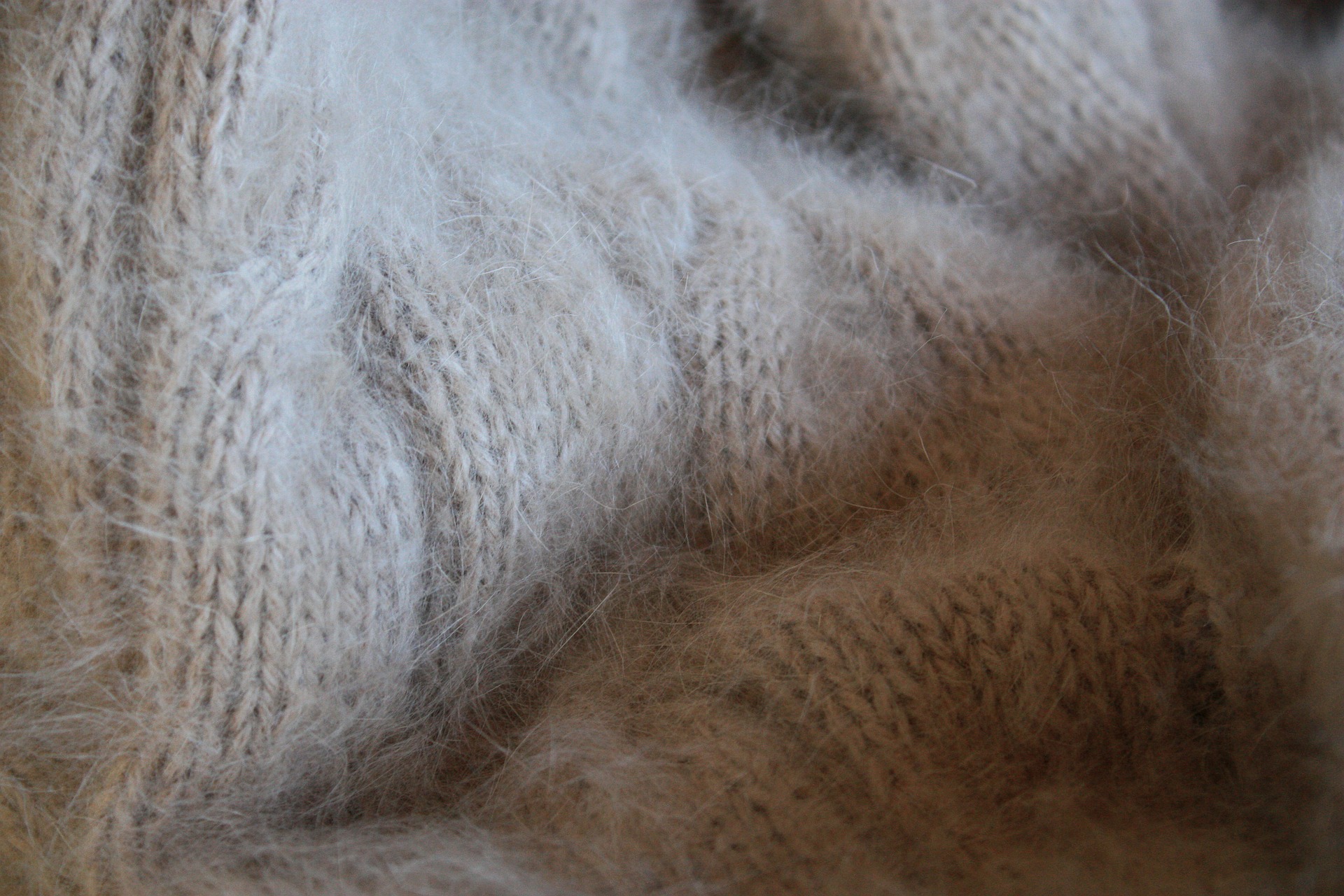
angora
Mohair is a fiber obtained from the Angora goat. The name Angora comes from the name of a city in Turkey. Native people have raised this type of goat for hundreds of years now. Today it is widely raised in Turkey, the United States, and South Africa. Angora goats are sheared twice a year, with the hair growing to about 4-6 inches (10-15 centimeters) long. If the Angora goat is sheared only once a year, the hair reaches a length of 12 inches (30 centimeters). The Angora goat's hair grows long enough to cover the body all the way to the ground, which makes it quite dirty and brownish in color — but once washed clean, it becomes pure white.
Viewed under a microscope, the shape of the fiber resembles wool, differing only in scale. Mohair's scales don't overlap, they merely meet edge to edge. The outer cells connect in a cone shape; viewed lengthwise along the fiber, the cross-sectional shape is nearly round. In thicker fibers, the outer cells resist abrasion well. The physical and chemical properties of mohair are close to those of wool.
Using mohair fiber has advantages over animal wool fiber in terms of durability, resisting abrasion well, having a sheen similar to silk fiber, and good elasticity, making it suitable for producing special novelty yarns, such as brushed yarn, loop yarn, and so on. It is used to make fabric for tailored suits, sportswear, blankets, upholstery fabric, curtains, and carpets, and can also be blended with other fibers for various uses as needed.
Mohair sweaters are quite popular; we often see them on TV in foreign series, such as Korean dramas and Japanese dramas.
The Korean-style fashion trend of pairing a ruedee t-shirt with a mohair sweater is guaranteed to make you look just like the leading man or lady on TV. Whichever series you watch, you need a TV with a sharp, clear picture. So we've got tips for choosing a TV for you here Which TV Brand Is Best