
Natural Fibers
Natural fibers fall into 4 main types, as follows:
-
Natural Cellulose Fibers (Natural cellulose fibers)
This is a group of fibers obtained from plants, such as cotton, linen, hemp, jute, and krajood (a type of sedge). The molecular structure consists of anhydroglucose units linked together into long chains, forming large molecules. A large number of these molecular chains combine to form fibers, and the longer they are, the greater the tenacity of the cellulose. The length of the molecular chain depends on the number of glucose molecules. Each glucose unit consists of 44.4% carbon, 1.2% hydrogen, and 49.4% oxygen.
The arrangement of cellulose molecules is, in some sections, parallel and orderly, known as Crystalline; in other sections it is disordered, tangled randomly, known as Amorphous. The disordered arrangement of cellulose molecules creates gaps between the molecules, resulting in weaker bonding between them and less fiber strength. Cellulose molecules that are arranged in an orderly manner give the fiber good stiffness with little elongation, with bonding between neighboring molecules provided by hydrogen bonds. The length of the linked cellulose molecular units depends on the type and original source of the cellulose.
From the molecular structure of glucose, which bonds together to form cellulose molecular chains, it can be seen that the glucose molecule has several -OH groups in several places, which are the sites where chemical reactions occur with the fiber, such as reactions with dyes and finishing agents, and moisture absorption, where the -OH groups readily bind with water molecules passing into the fiber.
-
Natural Protein Fibers (Protein Fibers)
Natural protein fibers (Natural protein fibers) Natural protein fibers are fibers obtained from animals, including hair fiber and silk fiber. Hair fiber is the fiber obtained from the hair covering an animal's body, such as sheep, goats, camels, llamas, alpacas, and vicuñas. The hair from these animals is called hair fiber and there is also another category of animal hair from smaller-bodied animals, such as mink, rabbit, and beaver, which yields softer fiber than the first type; this is called fur fiber
Silk fiber, on the other hand, is fiber obtained from the silkworm, which secretes a substance from a gland near its mouth to spin a cocoon around itself, allowing it to survive through a certain stage of its life cycle. The cocoon must be used before the silkworm pupa bores through and out of it, because doing so would break the silk fiber into short pieces, resulting in lower-quality silk fiber.
Natural protein fibers absorb moisture well and provide more warmth than cellulose fibers. They are poor electrical conductors, which can generate static electricity. They are not resistant to alkalis, dissolving in 5% sodium hydroxide when boiled, and are not resistant to chlorine-type bleaching agents. They are quite resistant to acids; however, silk fiber is not resistant to dissolving in concentrated mineral acids and is not resistant to sunlight — prolonged exposure to sunlight will change it from white to yellow. Tenacity decreases when the fiber is wet. When ignited, it burns slowly and self-extinguishes when removed from the flame. The ash forms small, hard, brittle round beads with a burning smell similar to human hair/fur or burnt flesh.
Natural protein fibers consist of amino acids linked together in chains in the form of polypeptide chains, with a relatively high molecular weight, composed of the elements carbon, hydrogen, oxygen, and nitrogen. Wool fiber also contains sulfur as a component. The arrangement of Alpha Amino Acid is distributed throughout the fiber.
The structure of fiber obtained from animal fur differs from that obtained from hair. Fiber from fur, when viewed under a microscope, has an outer layer of cells overlapping like fish scales. Fiber from hair has a straight, smooth, glossy outer appearance, is not very elastic, and has a uniformly smooth surface. Animals whose hair is used to make wool fabric include sheep; in addition, fiber is obtained from the hair of camels, angora goats, cashmere goats, llamas, alpacas, and vicuñas, which are classified as special types of animal hair that are very expensive and relatively rare.
Natural protein fibers have a lower density than natural cellulose fibers, making them lighter in weight than the same quantity of cellulose fiber. Protein fibers have good resilience and elasticity. At present, the use of natural protein fibers has not increased significantly, as large quantities of synthetic fibers such as nylon, polyester, and acrylic have been produced, and these can also be engineered and finished to have properties similar to natural protein fibers. Nevertheless, the use of protein fibers, especially those obtained from animal fur and hair, remains in demand in countries with cold climates.
-
Natural Mineral Fibers (Mineral Fibers)
Rock Fiber (Asbestos)
Asbestos fiber is a natural fiber separated from a type of green rock called Serpentine or amphibole rock, which has a slippery, soap-like layered texture. This type of rock has been known since ancient Greek and early Roman times. Asbestos is a Greek word.
The asbestos fiber obtained is cleaned, sorted by length, and then sent on to textile mills. To make asbestos fiber into fabric fiber, it must be blended with 5-20% cotton fiber, or alternatively with rayon and animal hair, in order to be spun into yarn and woven into fabric. Fabric produced from asbestos fiber has the property of being fire-resistant and can be woven into a variety of fabric types, used to make fire-retardant curtains, fireproof clothing for firefighters, electrical insulation fabric, and so on.
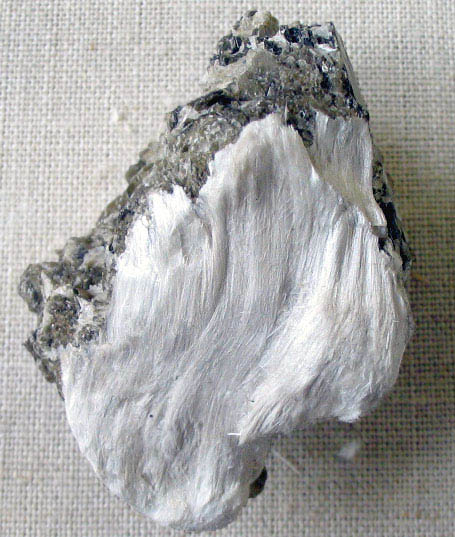
Image of asbestos fiber from rock. Source: https://en.wikipedia.org/wiki/Asbestos
Properties of Asbestos Fiber
Asbestos fiber is tenacious and strong, able to withstand high temperatures of up to 6,000F for short periods of time. Asbestos fiber is highly resistant to chemicals.
Cleaning Asbestos Fabric
Care must be taken when washing. If it is not very dirty, the whole piece should not be washed; instead, clean it by using a damp sponge to wipe the soiled area, which can be easily wiped away.
Metallic Fibers
This is a fiber that has been known for thousands of years, predating rayon and nylon. Metallic fiber is a monofilament, and may also be called Metallic Yarns, because it takes the form of a single long, ribbon-like filament that can be produced in any desired size, and may be wound alternately with a yarn to give a round appearance. It is typically made from genuine metal, such as gold — which is very expensive — silver, copper, and aluminum. Synthetic metallic fiber, on the other hand, is made from aluminum metal or plastic-coated metal. Substances sprayed over the metal include polyester compounds such as Mylar, or cellulose acetate-butyrate, which come in many bright, sparkling, and attractive colors, such as blue and gold, produced to imitate genuine metal. Plastic-coated metallic fiber is beneficial as it does not tarnish when exposed to air, salinity, or chlorine from water, and reacts differently to laundry detergent.
Properties of Metallic Fiber
The properties of metallic fiber are that it is not very tenacious; it is made for use in decorating garments rather than for weaving into whole pieces of fabric. If metallic fiber is coated or plated with polyester, the fiber becomes more tenacious and durable. If coated with acetate butyrate, it is used for making evening gowns, and the color will not run or fade when exposed to sunlight or during washing and ironing.
-
Natural Rubber Fiber (Natural Rubber Fiber)
Elastic rubber fiber is obtained from both natural rubber and synthetic rubber. The use of rubber fiber in clothing is usually in the form of elastic bands, with yarn or other types of fiber such as cotton, rayon, or nylon wrapped around the outside to add properties suited to the intended fabric use, and to prevent the rubber fiber from deteriorating quickly when exposed to heat and sunlight.
Beneficial Properties of Rubber Fiber for Practical Use
It stretches and recovers well, bends well, has moderate shape retention, and is tenacious and strong. It is resistant to water and air, difficult to cut or tear, and resistant to many types of chemicals. It has many uses, including making swimwear, muscle-support wraps, shoe lining fabric, sock cuffs, gloves, and elastic waistbands, among others.
Drawbacks of Rubber Fiber for Practical Use
Body oils or sweat and sunlight will degrade the rubber, causing it to stretch out of shape. Rubber fiber is not resistant to high heat — at temperatures above 93C it begins to break down. When stored for a long time, its tenacity decreases, its elasticity is lost over time, and certain types of detergent can also cause the fiber to deteriorate.